Community Engaged Scholars Faculty Research Mini-Grant Program
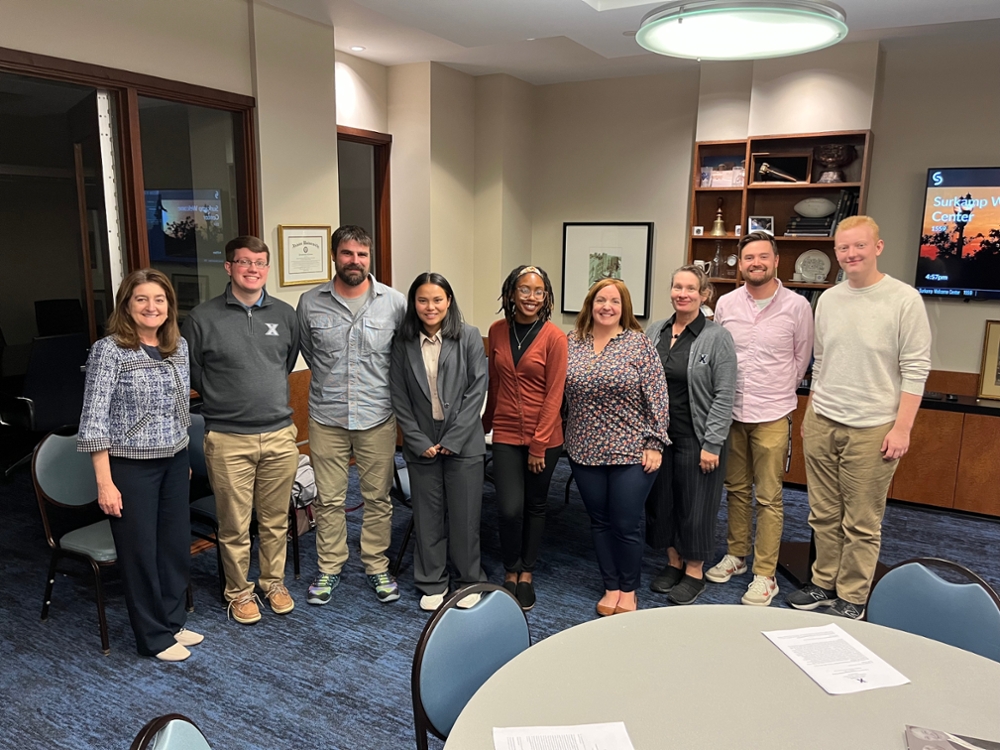
Photo Caption: Community-Engaged Scholars and their Community-Engaged Fellow research assistants
Are You Looking for Support for your Research?
The Community Engaged Scholars (CES) Faculty Research Mini-Grant Program is open to faculty who propose a research project that focuses on an investigation of community-engaged pedagogy and practices here at Xavier University or pursues research that engages community partners through shared academic and community goals. The program provides the opportunity for a Xavier University Community-Engaged Fellow (four-year service scholarship recipients) to support the faculty member’s scholarly work during the summer and provides additional assistance with the project through the fall semester. Grant recipients will also participate in a community of practice, engaging with faculty across the university.
Up to four upper-class Fellows are invited to be paid summer research assistants for Xavier faculty to support projects that address an identified community need or opportunity with a nonprofit partner and examine the broader impact of our teaching and learning.
The Community-Engaged Scholars program, sustained by the Center for Teaching Excellence and the Eigel Center for Community-Engaged Learning, support Xavier faculty in the implementation of research that engages community partners through shared academic and community goals. The program is designed to:
- Further the production of community-based and service-learning research by Xavier faculty;
- Improve community-engaged-learning pedagogy and practices using a research-based approach;
- Foster dialogue and support for faculty involved in community-based research;
- Provide the Eigel Center’s Community Engaged Fellows (CEF) a mentor in a collaborative community-engaged research experience.
To support small-scale research projects, the Eigel Center will distribute 2-4 awards in the form of a $1,000 stipend and a summer undergraduate student research assistant. These will be awarded faculty who elect to undertake and present a study in collaboration with a civic partner related to an identified community issue and/or examine the broader impact of community-engaged teaching and learning. The research can include quantitative, qualitative, mixed methods, or case studies.
Each faculty awardee will be paired with an undergraduate Community-Engaged Fellow (CEF) who will serve as a research assistant for 100 hours throughout summer 2026, with the possibility of extended fellow service through fall 2026. CEF’s are scholarship students from over 15 different majors experienced in community development principles and committed to weekly service over their four years.
Award recipients will gather at an orientation the end of the spring semester for fellowship and support, and awardees will present their research on to the Xavier Community in October 2026, as part of Family Weekend, and in spring 2027 during the Week of Research for the Community-Engaged Faculty Academy. In addition, the International Association for Research on Service-Learning and Community Engagement (IARSLCE) held annually in the fall is an excellent venue for presenting Scholarship on Teaching and Learning. The Eigel Center will support conference registration for mini-grant recipients who have papers accepted at the IARSLACE conference.
To apply, email a statement of interest to the Faculty Director of Community-Engaged Learning, Sheena Mugavin Steckl, at steckls@xavier.edu by April 1, 2026. A statement of interest should include:
- Description of the research goal/s. Provide context for the research and a description of the community partner. (250 words)
- Description of your proposed methodology and research plan. How do you propose to undertake this research? (150 words)
- Description of a plan to involve a Community Engaged Fellow as a Research Assistant. (250 words).
2025 Participating Faculty and Research Projects
Social Movements Under Threat
Dr. Bashir Tofangsazi, Department of RIGS
Earlier studies of social movements showed that factors such as collective identity and personal ties motivate individuals to participate in political activism. This project aims to focus on the impact of erosion of rights on participation in social movements. In recent years, members of the LGBTQ community and immigrants have faced increasing challenges. This includes but is not limited to erosion of legal rights and hostile rhetoric in the media. Given this environment, it would be important to analyze whether threats against the rights of such minority groups could stir people into action. Specifically, this project will analyze if people who do not have any personal ties, and do not identify with either one of the groups mentioned above, are more likely to contribute to advocacy groups in the face of such threats.
To answer this question, this project will assess three local nonprofits; Cincinnati Pride, Cincinnati Black Pride, and Ignite Peace. The first two organizations mainly focus on organizing the yearly Pride event while the latter addresses a wider variety of issue ranging from immigration to criminal justice reform. What these organizations have in common is that they all serve communities whose rights have been under legal and rhetorical attack during recent years. This project will analyze whether such threats could encourage citizens to contribute to civil rights organization due to their personal values, rather than their social ties or identities.
Intergroup Civic Climate Dialog
Dr. Anas Malik, Department of Policial Science
The goal of the research is to implement the intergroup civic dialogue for a problem-solving method that I developed last summer. The project builds on the work of Vincent Ostrom on civic artisanship, my own prior work on interreligious collective action (both in scholarly publications and in over two decades with the National Muslim Catholic Dialogue). Further, it draws on Essential Partners, a well-established bridge-building organization, whose dialogue training I recently completed, and the recent social psychological literature on awe.
The project will generate information about the value of the proposed technique in the manner of a pilot study, and also trouble-shoot any unanticipated issues. Last summer, I wrote and presented a paper at a conference of the Ostrom Workshop at Indiana University in Bloomington, which outlined the proposal for inter community problem solving that deliberately uses frisson and awe to expand the sense of self and imagination of participants, with the goal of improved civic problem-solving (the paper is attached; it includes references and more detailed explanation of the concepts mentioned here).
The community partner for this is Faith Communities Go Green, a collaboration of Equasion and Green Umbrella, one whose steering committee I have served since its inception. Actual meetings may be held at the YMCA facility near Xavier (the Music Resource Center), and at the Islamic Center of Greater Cincinnati. The particular issue area is likely to be managing the influx into the Greater Cincinnati region from California, Florida, and other climate-displaced persons.
What We Learned From a Multi-Semester Community-Engaged Learning Cohort
Dr. Sheena Steckl, Department of English
This research project is centered on an experimental multi-semester community-engaged learning cohort of first-year students started at Xavier in fall 2023. A thorough review of literature tells us that both learning cohorts and community-engaged learning courses can increase student feeling of belonging on campus and improve both grades and retention. The community-engaged learning cohort took the same ENGL 101 and ENGL 205 instructor in the fall and spring semesters their first year in an attempt to discern is academic or interpersonal outcomes were more favorable than those of traditional first-year students.
Concomitant to the cohort learning in community was a survey to all first-year students given at the conclusion of their ENGL 101 course, which is taken in either fall or spring of their first year. The survey assessed student belonging and campus services or experiences that do or do not promote belonging on our campus. We are analyzing survey findings to ascertain if a community-engaged learning cohort model should be more broadly adopted on campus, or what practices and programs should be better supported.
2024 Participating Faculty
- Dr. Supaporn Kradtap-Hartwell, Department of Chemistry
- Dr. Karim Tiro, Department of History
- Dr. Bashir Tofangsazi, Department of RIGS
- Dr. Sheena Steckl, Department of English
2023 Participating Faculty
- Dr. Kathleen Hart, School of Psychology
- Dr. Richie Liu, Department of Marketing
- Dr. Renea Frey, Department of English
2022 Participating Faculty
- Dr. Leah Dunn, Department of Occupational Therapy
- Dr. Diane Ceo-DiFrancesco, Department of Classics and Modern Languages
- Dr. Kathleen Hart, School of Psychology
- Dr. Matthew D. Regele, Department of Management & Entrepreneurship
- Dr. Jeffrey Gerding, Department of English
- Dr. Terri Enslein, College of Nursing
2021 Participating Faculty
- Kathleen Timmerman, Assistant Professor, Department of Computer Science
- ShaDawn Battle, Assistant Professor, Gender and Diversity Studies Program
- Lauren Angelone, Assistant Professor of Science Education and Instructional Technology, Department of Education
- Supaporn Kradtap-Hartwell, Associate Professor, Department of Chemistry
- Kathleen Smythe, Associate Professor, Department of History
- Stacey Raj, Assistant Professor, Department of Psychology
- Mich Nyawalo, Associate Professor, Diversity and Gender Studies Program
- Thomas Wagner, Associate Professor, Department Communication Studies
2020 Participating Faculty
- Christine Anderson, Associate Professor, Department of History
- Diane Ceo-DiFrancesco, Associate Professor, Department of Classics & Modern Languages, Jennifer Gibson, Associate Professor, Department of Psychology, and Leah Dunn, Assistant Professor, Department of Occupational Therapy
- John Fairfield, Professor, Department of History
- Anne Fuller, Assistant Professor, Department of Psychology
- Tammy Sonnentag, Assistant Professor, Department of Psychology
- Joan Tunningly and Stacia Galey, Clinical Faculty, Department of Occupational Therapy
- Carol Winkelmann, Chair & Professor, Department of English
2019 Participating Faculty
- Eileen Alexander, Assistant Professor, Health Services Administration
- Christine Anderson, Associate Professor, Department of History
- Leah Dunn, Assistant Professor, Department of Occupational Therapy
- Diane Ceo-DiFrancesco, Associate Professor, Department of Classics and Modern Languages
- Renea Frey, Assistant Professor, Department of English
- Jeffrey Gerding, Assistant Professor, Department of English
- Cheryl Jonson, Associate Professor, Department of Criminal Justice