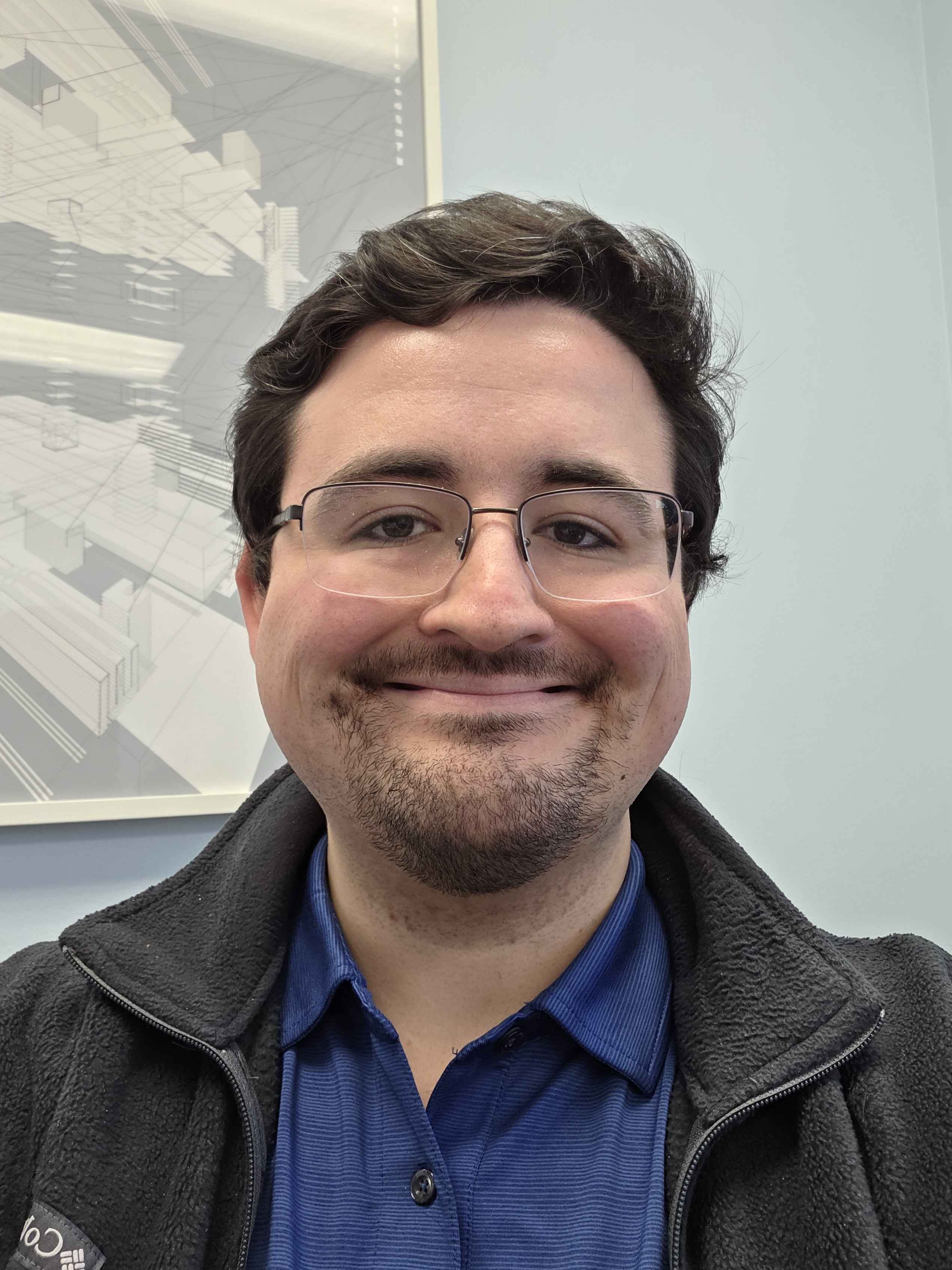
Hagan Miller
Professor, 3D Animation and Game Design
Originally from Drexel, NC, Hagan Miller received his BA in Architecture from Carnegie Mellon University in 2021 with minors in Game Design and Physical Computing. After his undergraduate degree, Hagan continued his studies into his master's to achieve a Masters of Entertainment Technology from Carnegie Mellon's ETC program. While at CMU, Hagan participated and helped create multiple projects including the 2nd place finalist at the national IEEE Game Sig for the game "Project Ecotopia" which is free and available to download. With a particular focus on 3D Modeling, Environments, Animation, and more. He has joined as a Teaching Professor in 3D Animation and Immersive Game Design in 2026.
Welcome, Hagan Miller!
Hagan is the newest member of the Art Department Faculty and will be building the new 3D Animation and Immersive Game Design Program. To get to know him, a bit better, we asked him a few questions:
Q: What drew you to 3D animation and immersive game design, and what has your journey in the field looked like?
Hagan: I have always been interested in games, even since I was a little kid. I was designing cards for Card-Jitsu for club penguin, trying to understand what made them work. I competed in high school at some local and a state competition in Super Smash Bros. Once I got to college, I actually started in architecture, but I was always pulled to designing for games. I ended up getting two minors in my undergraduate studies, one of which being game design. I used my momentum from that minor to pursue my Masters in Entertainment Technology. This helped me flesh out my expertise while rounding me out on the entire development pipeline. In terms of professional work, I've been on a mix of small and medium sized studio teams, focusing most on game design and the 3D development pipeline.
Q: This program sits at the intersection of technology, storytelling, gameplay, and the visual arts. What excites you about bringing these disciplines together?
Hagan: I've always said that game design is where art meets science. What I mean by that is that it is the culmination of a large sum of different studies, fields, expertise, and more that come together to make something exciting. You get different people from all walks of life, different backgrounds, different goals, and different views all agreeing to make something designed to bring a bit more light into the world, whether that be through fun, storytelling, or even teaching a brand-new skill.
Q: What can students learn by working alongside people with different creative and technical strengths?
Hagan: The first thing you learn generally is to have respect for the sheer work and effort that is required to make something great. It is very easy to get caught up in a final product, especially when you are used to being the consumer. In addition to that, you also gain a better understanding of how the behind-the-scenes aspects of how some of the greatest creations are made. It can give a sense of inspiration you may not have previously have had access to.
Q: Can you tell us about a project or experience in your career where interdisciplinary collaboration made the work stronger?
Hagan: Project Ecotopia, a game centered around visualizing a better future, was designed and developed by myself and a handful of extremely talented students during our Masters'. A couple of us weren't from the U.S., had different beliefs and skillsets, but we all had a unified vision on what the message of the game was going to be. By listening, prototyping, iterating, and debating on how different aspects should be implemented to achieve that vision, we ended up with a better game than any of us could have made on our own in triple the time.
Q: When students graduate from this program, what do you hope they will be able to create together that they couldn't have made on their own?
Hagan: As part of the 3D Animation and Immersive Game Design Program, it is expected students will be able to work as a team to create concrete video game that show who they are as students, something they feel proud of as individuals and as a team. Scope is one of the quickest bottlenecks in any game development and while solo dev games exist, they are exceptionally rare. The breadth and depth of the final product is able to be a deeper investigation than they could pull off on their own in the same amount of time.
Originally from Drexel, NC, Hagan Miller received his BA in Architecture from Carnegie Mellon University in 2021 with minors in Game Design and Physical Computing. After his undergraduate degree, Hagan continued his studies into his master's to achieve a Masters of Entertainment Technology from Carnegie Mellon's ETC program. While at CMU, Hagan participated and helped create multiple projects including the 2nd place finalist at the national IEEE Game Sig for the game "Project Ecotopia" which is free and available to download. With a particular focus on 3D Modeling, Environments, Animation, and more. He has joined as a Teaching Professor in 3D Animation and Immersive Game Design in 2026.
Welcome, Hagan Miller!
Hagan is the newest member of the Art Department Faculty and will be building the new 3D Animation and Immersive Game Design Program. To get to know him, a bit better, we asked him a few questions:
Q: What drew you to 3D animation and immersive game design, and what has your journey in the field looked like?
Hagan: I have always been interested in games, even since I was a little kid. I was designing cards for Card-Jitsu for club penguin, trying to understand what made them work. I competed in high school at some local and a state competition in Super Smash Bros. Once I got to college, I actually started in architecture, but I was always pulled to designing for games. I ended up getting two minors in my undergraduate studies, one of which being game design. I used my momentum from that minor to pursue my Masters in Entertainment Technology. This helped me flesh out my expertise while rounding me out on the entire development pipeline. In terms of professional work, I've been on a mix of small and medium sized studio teams, focusing most on game design and the 3D development pipeline.
Q: This program sits at the intersection of technology, storytelling, gameplay, and the visual arts. What excites you about bringing these disciplines together?
Hagan: I've always said that game design is where art meets science. What I mean by that is that it is the culmination of a large sum of different studies, fields, expertise, and more that come together to make something exciting. You get different people from all walks of life, different backgrounds, different goals, and different views all agreeing to make something designed to bring a bit more light into the world, whether that be through fun, storytelling, or even teaching a brand-new skill.
Q: What can students learn by working alongside people with different creative and technical strengths?
Hagan: The first thing you learn generally is to have respect for the sheer work and effort that is required to make something great. It is very easy to get caught up in a final product, especially when you are used to being the consumer. In addition to that, you also gain a better understanding of how the behind-the-scenes aspects of how some of the greatest creations are made. It can give a sense of inspiration you may not have previously have had access to.
Q: Can you tell us about a project or experience in your career where interdisciplinary collaboration made the work stronger?
Hagan: Project Ecotopia, a game centered around visualizing a better future, was designed and developed by myself and a handful of extremely talented students during our Masters'. A couple of us weren't from the U.S., had different beliefs and skillsets, but we all had a unified vision on what the message of the game was going to be. By listening, prototyping, iterating, and debating on how different aspects should be implemented to achieve that vision, we ended up with a better game than any of us could have made on our own in triple the time.
Q: When students graduate from this program, what do you hope they will be able to create together that they couldn't have made on their own?
Hagan: As part of the 3D Animation and Immersive Game Design Program, it is expected students will be able to work as a team to create concrete video game that show who they are as students, something they feel proud of as individuals and as a team. Scope is one of the quickest bottlenecks in any game development and while solo dev games exist, they are exceptionally rare. The breadth and depth of the final product is able to be a deeper investigation than they could pull off on their own in the same amount of time.
First Year at Xavier
2026
- BA in Architecture from Carnegie Mellon University in 2021 with minors in Game Design and Physical Computing, Masters of Entertainment Technology from Carnegie Mellon's ETC program