Ignatian Pedagogical Paradigm (IPP)
Educating the whole person through learning experiences that intentionally support reflection, engagement, discernment, and growth in any discipline.
Designing Learning Experiences That Form the Whole Person
At Xavier, course design is not only about delivering content. It is about creating learning experiences that help students grow intellectually, ethically, professionally, and personally. In the Jesuit tradition, this broader process of intellectual and personal growth is often described as formation: the development of students not only as learners, but as thoughtful professionals, community members, and human beings.
The Ignatian Pedagogical Paradigm (IPP) emerged from the Jesuit educational tradition as a way of thinking intentionally about how learning shapes the whole person. Rooted in the Jesuit value of cura personalis (care for the whole person), IPP recognizes that students bring prior experiences, identities, perspectives, questions, and aspirations into the learning process. Meaningful education involves more than the transmission of information—it invites students to engage deeply, reflect critically, make connections, and consider how their learning relates to the world around them.
IPP is fundamentally about how students experience and process learning. Rather than functioning as a rigid teaching model, it helps faculty design courses that encourage students to engage deeply with ideas, connect learning to lived experience, think critically about meaning and values, and apply their learning in purposeful ways.
Understanding IPP
The Five Dimensions of Learning
The Ignatian Pedagogical Paradigm is organized around five interconnected dimensions: Context, Experience, Reflection, Action, and Evaluation. Together, these dimensions describe how students encounter, process, apply, and grow through learning experiences.
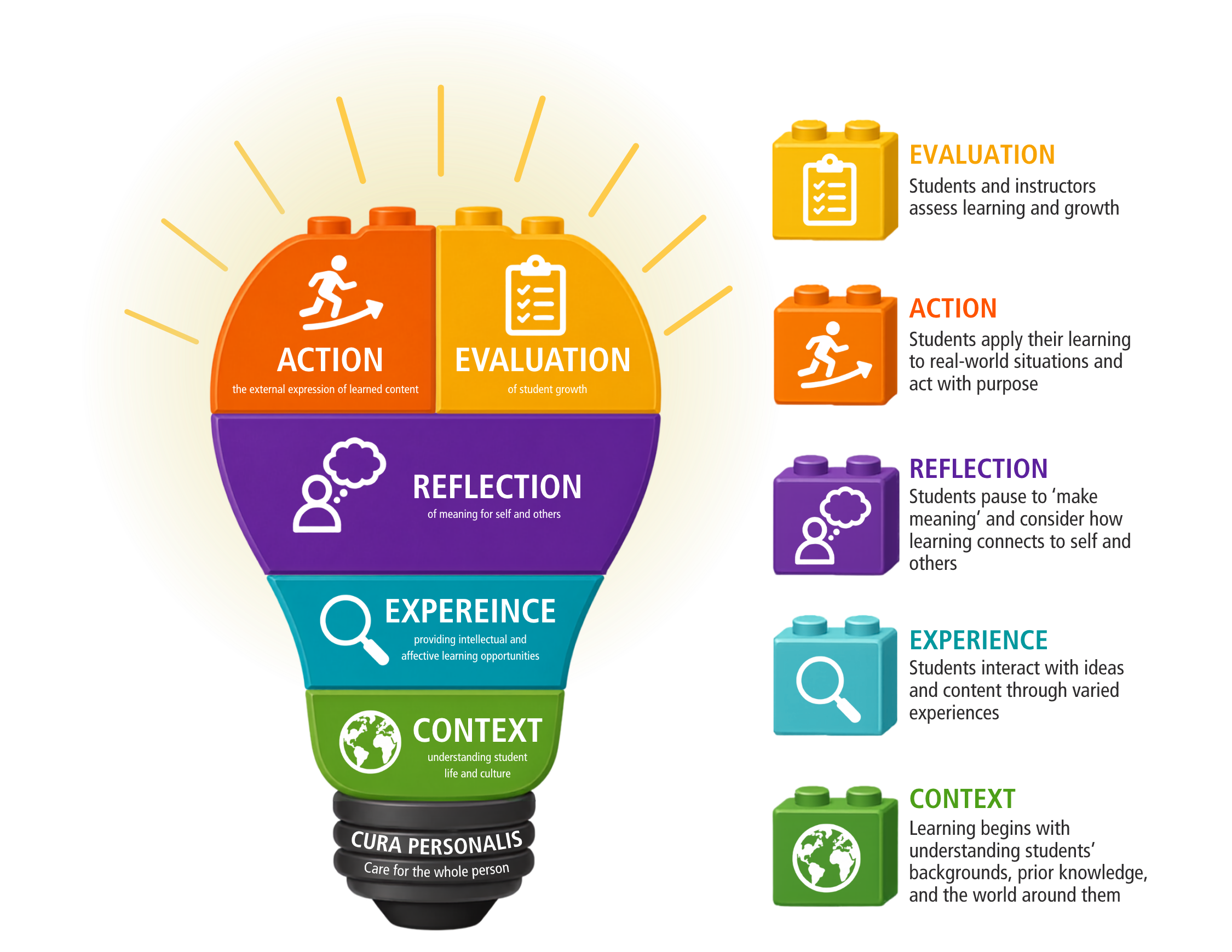
This framework is not a rigid sequence or checklist. Learning moves dynamically between experience, reflection, application, and feedback over time. Reflection often occurs during experience, not only after it. Evaluation informs new context. Action creates new experiences that call for further reflection. Understanding IPP as a dynamic, ongoing cycle rather than a checklist is essential to applying it.
How IPP differs
A Different Way of Thinking About Teaching and Learning
IPP does not replace disciplinary rigor or established pedagogy. It deepens learning by integrating experience, meaning-making, ethical awareness, and application into how courses are designed and facilitated.
| Common Instructional Models | Ignatian Pedagogical Paradigm |
|---|---|
| Focus primarily on content delivery | Focuses on formation of the whole person through learning |
| Learning often ends with knowledge demonstration | Learning moves toward reflection, discernment, and responsible action |
| Instructor transmits information | Instructor guides students in intellectual and personal growth |
| Students primarily consume information, often passively | Students interpret, reflect, discern, and apply information |
| Reflection may be optional or absent | Reflection is essential to the learning process |
| Assessment emphasizes mastery of content | Evaluation includes intellectual growth and development over time |
| Course design begins with content and topics | Course design begins with learners and their context |
The faculty role
Accompanying Students in Growth
In IPP, expertise remains important, but the instructor's role extends beyond transmitting information to passive recipients. The instructor creates conditions for meaningful learning, accompanies students in intellectual and personal growth, facilitates reflection and discernment, and helps students connect learning to real life and responsibility.
This means the most important design questions shift from "What content do I need to cover?" toward questions like:
- Who are my students, and what experiences and assumptions do they bring into this course?
- How will students actively engage the material, not just receive it?
- Where will students pause to reflect on meaning, implications, and their own thinking?
- How might this learning shape students' attitudes, values, or decisions?
- What opportunities exist for students to apply or respond to what they have learned?
- How will students recognize and reflect on their own growth over time?
IPP in your Canvas course
What IPP Looks Like in Practice
Designing with IPP begins by considering how students encounter, engage with, and make meaning of your course material. The five dimensions can be woven into the courses you already teach through small, intentional additions: a framing question that connects content to student experience, a structured moment to pause and reflect, an activity that asks students to apply rather than just absorb.
| IPP does not... | IPP does... |
|---|---|
| Require adding theology or religious content to your course | Offer a pedagogical framework that supports intentional learning in any discipline, including STEM, healthcare, business, and professional programs |
| Conflict with academic rigor or disciplinary standards | Deepen learning by integrating authentic assessment, critical thinking, and applied reasoning alongside disciplinary content |
| Require long personal journaling or highly emotional reflection | Support reflection in many forms: a brief exit ticket, a guided discussion prompt, or a structured metacognitive response all count |
| Follow a rigid step-by-step sequence | Describe five interconnected dimensions that work as a dynamic cycle: reflection happens during experience, evaluation informs new context, action creates new experiences |
| Require adding extra content or assignments to your course | Invite small, intentional shifts in how activities are framed, how reflection is built in, and how students connect learning to application |
| Replace what faculty are already doing | Help name and strengthen practices many faculty already use: intentional design, authentic assessment, active learning, and care for student growth |
IPP in course design
Applying IPP Across Course Design Decisions
IPP is not about adding more content or extra assignments. Often, small shifts in how activities are framed, how reflection is incorporated, or how students connect learning to application can significantly deepen engagement and meaning-making.
| Course Design Area | IPP-Informed Design Choices |
|---|---|
| Learning Outcomes |
What should students know, do, and become? Include critical thinking, ethical reasoning, reflection, or real-world application where appropriate for your discipline. |
| Learning Activities |
How will students actively experience the material? Create opportunities for discussion, reflection, collaboration, and applied learning that ask students to engage, not just receive. |
| Assessments |
How will students demonstrate learning and recognize growth? Use authentic assessments that ask students to apply learning in meaningful, discipline-specific contexts; build in feedback and revision. |
| Learning Materials |
How do materials invite students to think, question, and connect? Include diverse perspectives, real-world cases, and resources that invite critical engagement rather than passive reading. |
| Feedback & Support |
How does feedback help students grow and continue learning? Provide timely, formative feedback and revision opportunities that treat assessment as part of the learning process, not the end of it. |
| Course Organization |
How does the course structure support student understanding and trust? Structure the course so students can see connections between activities, understand why materials matter, and anticipate what comes next. |
Reflection as a learning strategy
Helping Students Make Meaning of Learning
Reflection is one of the most powerful practices for deepening learning. It helps students move beyond memorization toward genuine understanding, personal meaning-making, and ethical awareness.
Reflection does not need to be lengthy or highly personal to be effective. Even brief, structured opportunities to pause and process can strengthen retention and thoughtful engagement. The prompts below can be adapted for "Pause and Reflect" moments in lesson pages, discussion posts, journal entries, exit tickets, or in-class activities.
Cura personalis & inclusive design
Caring for the Whole Learner
Students bring different experiences, identities, strengths, challenges, and ways of learning into every classroom. Designing courses with flexibility, clarity, accessibility, and multiple opportunities for engagement helps create learning environments where all students can participate meaningfully.
- Clarity & Transparency: Students learn more effectively when they understand what is expected and why.
- Accessibility & Flexibility: Reducing barriers to participation helps all students engage, not just those with documented accommodations.
- Belonging & Engagement: Students engage more deeply when they see themselves reflected in the course and feel their presence matters.
AI & Ignatian pedagogy
Designing Learning in an Age of Artificial Intelligence
Generative AI tools are rapidly changing how students access information, produce content, solve problems, and approach learning. These technologies create new opportunities for creativity, efficiency, personalization, and exploration, but they also raise important questions about intellectual engagement, ethical reasoning, and critical thinking.
The IPP framework can be helpful for thinking about AI not simply as a technology tool, but as part of the broader learning environment students now inhabit. Rather than focusing only on whether AI should or should not be used, IPP encourages us to ask deeper questions:
- How does AI shape the way students experience learning?
- What intellectual habits might AI strengthen or weaken?
- Where should students critically reflect on the meaning, ethics, limitations, and implications of AI-generated work?
- How can courses help students use AI thoughtfully, responsibly, and transparently?
- What kinds of learning experiences still require human judgment, discernment, creativity, collaboration, and reflection?
| IPP Dimension | AI-Informed Design Questions | Examples |
|---|---|---|
| Context | How are students already using AI? What assumptions, habits, opportunities, or anxieties do they bring into the course? | Discuss AI use openly · establish expectations · explore disciplinary norms · examine how AI affects the profession or field |
| Experience | How will students actively engage with ideas and practice rather than passively outsourcing thinking? | Use AI for brainstorming, comparison, critique, simulation, or drafting while preserving opportunities for authentic analysis and decision-making |
| Reflection | How will students examine the quality, ethics, limitations, biases, and implications of AI-generated content? | Compare AI and human responses · analyze bias · reflect on learning processes · discuss intellectual ownership and academic integrity |
| Action | How will students apply learning responsibly and thoughtfully in AI-rich professional and social contexts? | Create AI-supported projects · develop ethical guidelines · evaluate real-world uses of AI in the discipline |
| Evaluation | How will assessments measure student thinking, reasoning, growth, and understanding rather than only final products? | Process-based assignments · drafts and revisions · oral explanation · authentic assessment · reflection on AI use |
As AI tools make information generation faster and easier, students need even more opportunities to question, interpret, evaluate, discern, and make meaning from what they encounter.
IPP across the resource center
A Framework, Not a Checklist
The pages in this section of the IDT Resource Center (outcomes, assessments, activities, and materials) each reflect IPP principles in practice. Intentional alignment, authentic assessment, active learning, reflection, and inclusive design are not separate instructional design concepts bolted onto a Jesuit mission statement. They are expressions of the same underlying commitment to designing learning experiences for the whole learner.
- Learning Outcomes reflect the full range of what students should know, do, and become, including how they think, reason, and engage with complexity.
- Assessments give students meaningful opportunities to demonstrate learning in authentic, context-rich ways and grow from feedback.
- Learning Activities create the experiences through which students encounter ideas, practice skills, reflect, and collaborate.
- Learning Materials shape how students encounter knowledge, whose voices they hear, and what questions they are invited to consider.